Sunday, December 21, 2014
id floweres: Flower and details
id floweres: Flower and details: Flower "All the flowers would have very extra special powers" This is a quote from Lewis Carroll's Alice in Wonderland...

Pollination mechanism
Pollination mechanism
The pollination mechanism employed by a plant depends on what method of pollination is utilized.
Most flowers can be divided between two broad groups of pollination methods:
Entomophilous: flowers attract and use insects, bats, birds or other animals to transfer pollen from one flower to the next. Often they are specialized in shape and have an arrangement of the stamens that ensures that pollen grains are transferred to the bodies of the pollinator when it lands in search of its attractant (such as nectar, pollen, or a mate). In pursuing this attractant from many flowers of the same species, the pollinator transfers pollen to the stigmas—arranged with equally pointed precision—of all of the flowers it visits. Many flowers rely on simple proximity between flower parts to ensure pollination. Others, such as the Sarracenia or lady-slipper orchids, have elaborate designs to ensure pollination while preventing self-pollination.

Anemophilous: flowers use the wind to move pollen from one flower to the next, examples include the grasses, Birch trees, Ragweed and Maples. They have no need to attract pollinators and therefore tend not to grow large blossoms. Whereas the pollen of entomophilous flowers tends to be large-grained, sticky, and rich in protein (another "reward" for pollinators), anemophilous flower pollen is usually small-grained, very light, and of little nutritional value toinsects, though it may still be gathered in times of dearth. Honeybees and bumblebees actively gather anemophilous corn (maize) pollen, though it is of little value to them.
Some flowers are self-pollinated and use flowers that never open or are self-pollinated before the flowers open, these flowers are called cleistogamous. Many Viola species and some Salvia have these types of flowers.
Attraction methods
Attraction methods

Plants cannot move from one location to another, thus many flowers have evolved to attract animals to transfer pollen between individuals in dispersed populations. Flowers that are insect-pollinated are called entomophilous; literally "insect-loving" in Greek. They can be highly modified along with the pollinating insects by co-evolution. Flowers commonly have glands called nectaries on various parts that attract animals looking for nutritious nectar. Birds and bees have color vision, enabling them to seek out "colorful" flowers.
Some flowers have patterns, called nectar guides, that show pollinators where to look for nectar; they may be visible only under ultraviolet light, which is visible to bees and some other insects. Flowers also attract pollinators by scent and some of those scents are pleasant to our sense of smell. Not all flower scents are appealing to humans; a number of flowers are pollinated by insects that are attracted to rotten flesh and have flowers that smell like dead animals, often called Carrion flowers, including Rafflesia, the titan arum, and the North American pawpaw (Asimina triloba). Flowers pollinated by night visitors, including bats and moths, are likely to concentrate on scent to attract pollinators and most such flowers are white.
Other flowers use mimicry to attract pollinators. Some species of orchids, for example, produce flowers resembling female bees in color, shape, and scent. Male bees move from one such flower to another in search of a mate.
Pollination and Pollen
Pollination
Main article: Pollination

The primary purpose of a flower is reproduction. Since the flowers are the reproductive organs of plant, they mediate the joining of the sperm, contained within pollen, to the ovules — contained in the ovary. Pollination is the movement of pollen from the anthers to the stigma. The joining of the sperm to the ovules is called fertilization. Normally pollen is moved from one plant to another, but many plants are able to self pollinate. The fertilized ovules produce seeds that are the next generation. Sexual reproduction produces genetically unique offspring, allowing for adaptation. Flowers have specific designs which encourages the transfer of pollen from one plant to another of the same species. Many plants are dependent upon external factors for pollination, including: wind and animals, and especially insects. Even large animals such as birds, bats, and pygmy possums can be employed. The period of time during which this process can take place (the flower is fully expanded and functional) is called anthesis. The study of pollination by insects is called anthecology.
Pollen
The types of pollen that most commonly cause allergic reactions are produced by the plain-looking plants (trees, grasses, and weeds) that do not have showy flowers. These plants make small, light, dry pollen grains that are custom-made for wind transport.
The type of allergens in the pollen is the main factor that determines whether the pollen is likely to cause hay fever. For example, pine tree pollen is produced in large amounts by a common tree, which would make it a good candidate for causing allergy. It is, however, a relatively rare cause of allergy because the types of allergens in pine pollen appear to make it less allergenic.[18]
Among North American plants, weeds are the most prolific producers of allergenic pollen.[19] Ragweed is the major culprit, but other important sources are sagebrush, redroot pigweed, lamb’s quarters, Russian thistle (tumbleweed), and English plantain.
There is much confusion about the role of flowers in allergies. For example the showy and entomophilous goldenrod(Solidago) is frequently blamed for respiratory allergies, of which it is innocent, since its pollen cannot be airborne. Instead the allergen is usually the pollen of the contemporary bloom of anemophilous ragweed (Ambrosia), which can drift for many kilometers.
Scientists have collected samples of ragweed pollen 400 miles out at sea and 2 miles high in the air.[18] A single ragweed plant can generate a million grains of pollen per day.[20]
It is common to hear people say they are allergic to colorful or scented flowers like roses. In fact, only florists, gardeners, and others who have prolonged, close contact with flowers are likely to be sensitive to pollen from these plants. Most people have little contact with the large, heavy, waxy pollen grains of such flowering plants because this type of pollen is not carried by wind but by insects such as butterflies and bees.
Flower specialization and pollination
Flower specialization and pollination
Further information: Pollination syndrome
Flowering plants usually face selective pressure to optimize the transfer of their pollen, and this is typically reflected in the morphology of the flowers and the behaviour of the plants. Pollen may be transferred between plants via a number of 'vectors'. Some plants make use of abiotic vectors — namely wind (anemophily) or, much less commonly, water (hydrophily). Others use biotic vectors including insects (entomophily), birds (ornithophily), bats (chiropterophily) or other animals. Some plants make use of multiple vectors, but many are highly specialised.
Cleistogamous flowers are self-pollinated, after which they may or may not open. Many Viola and some Salvia species are known to have these types of flowers.
The flowers of plants that make use of biotic pollen vectors commonly have glands called nectaries that act as an incentive for animals to visit the flower. Some flowers have patterns, called nectar guides, that show pollinators where to look for nectar. Flowers also attract pollinators by scent and color. Still other flowers use mimicry to attract pollinators. Some species of orchids, for example, produce flowers resembling female bees in color, shape, and scent. Flowers are also specialized in shape and have an arrangement of the stamens that ensures that pollen grains are transferred to the bodies of the pollinator when it lands in search of its attractant (such as nectar, pollen, or a mate). In pursuing this attractant from many flowers of the same species, the pollinator transfers pollen to the stigmas—arranged with equally pointed precision—of all of the flowers it visits.
Anemophilous flowers use the wind to move pollen from one flower to the next. Examples include grasses, birch trees, ragweed and maples. They have no need to attract pollinators and therefore tend not to be "showy" flowers. Male and female reproductive organs are generally found in separate flowers, the male flowers having a number of long filaments terminating in exposed stamens, and the female flowers having long, feather-like stigmas. Whereas the pollen of animal-pollinated flowers tends to be large-grained, sticky, and rich in protein (another "reward" for pollinators), anemophilous flower pollen is usually small-grained, very light, and of little nutritional value to animals.
Floral function
Floral function

The principal purpose of a flower is the reproduction of the individual and the species. All flowering plants are heterosporous, producing two types of spores. Microspores are produced by meiosis inside anthers while megaspores are produced inside ovules, inside an ovary. In fact, anthers typically consist of four microsporangia and an ovule is an integumented megasporangium. Both types of spores develop into gametophytes inside sporangia. As with all heterosporous plants, the gametophytes also develop inside the spores (are endosporic).
In the majority of species, individual flowers have both functional carpels and stamens. Botanists describe these flowers as being perfect or bisexual and the species as hermaphroditic. Some flowers lack one or the other reproductive organ and called imperfect or unisexual. If unisex flowers are found on the same individual plant but in different locations, the species is said to bemonoecious. If each type of unisex flower is found only on separate individuals, the plant is dioecious.
Inflorescence and more
Inflorescence

Main article: Inflorescence
In those species that have more than one flower on an axis, the collective cluster of flowers is termed an inflorescence. Some inflorescences are composed of many small flowers arranged in a formation that resembles a single flower. The common example of this is most members of the very large composite (Asteraceae) group. A single daisy or sunflower, for example, is not a flower but a flower head—an inflorescence composed of numerous flowers (or florets). An inflorescence may include specialized stems and modified leaves known as bracts.
Floral diagrams and floral formulae
Main articles: Floral formula and Floral diagram
A floral formula is a way to represent the structure of a flower using specific letters, numbers and symbols, presenting substantial information about the flower in a compact form. It can represent a taxon, usually giving ranges of the numbers of different organs, or particular species. Floral formulae have been developed in the early 19th century and their use has declined since. Prenner et al. (2010) devised an extension of the existing model to broaden the descriptive capability of the formula.[6]The format of floral formulae differs in different parts of the world, yet they convey the same information.[7][8][9][10]
The structure of a flower can also be expressed by the means of floral diagrams. The use of schematic diagrams can replace long descriptions or complicated drawings as a tool for understanding both floral structure and evolution. Such diagrams may show important features of flowers, including the relative positions of the various organs, including the presence of fusion and symmetry, as well as structural details.[7]
Flowering transition
The transition to flowering is one of the major phase changes that a plant makes during its life cycle. The transition must take place at a time that is favorable for fertilization and the formation of seeds, hence ensuring maximalreproductive success. To meet these needs a plant is able to interpret important endogenous and environmental cues such as changes in levels of plant hormones and seasonable temperature and photoperiod changes.[15] Manyperennial and most biennial plants require vernalization to flower. The molecular interpretation of these signals is through the transmission of a complex signal known as florigen, which involves a variety of genes, including CONSTANS, FLOWERING LOCUS C and FLOWERING LOCUS T. Florigen is produced in the leaves in reproductively favorable conditions and acts in buds and growing tips to induce a number of different physiological and morphological changes.[16]
The first step of the transition is the transformation of the vegetative stem primordia into floral primordia. This occurs as biochemical changes take place to change cellular differentiation of leaf, bud and stem tissues into tissue that will grow into the reproductive organs. Growth of the central part of the stem tip stops or flattens out and the sides develop protuberances in a whorled or spiral fashion around the outside of the stem end. These protuberances develop into the sepals, petals, stamens, and carpels. Once this process begins, in most plants, it cannot be reversed and the stems develop flowers, even if the initial start of the flower formation event was dependent of some environmental cue.[17] Once the process begins, even if that cue is removed the stem will continue to develop a flower.
Organ development

The molecular control of floral organ identity determination appears to be fairly well understood in some species. In a simple model, three gene activities interact in a combinatorial manner to determine the developmental identities of the organ primordia within the floral meristem. These gene functions are called A, B and C-gene functions. In the first floral whorl only A-genes are expressed, leading to the formation of sepals. In the second whorl both A- and B-genes are expressed, leading to the formation of petals. In the third whorl, B and C genes interact to form stamens and in the center of the flower C-genes alone give rise to carpels. The model is based upon studies ofhomeotic mutants in Arabidopsis thaliana and snapdragon, Antirrhinum majus. For example, when there is a loss of B-gene function, mutant flowers are produced with sepals in the first whorl as usual, but also in the second whorl instead of the normal petal formation. In the third whorl the lack of B function but presence of C-function mimics the fourth whorl, leading to the formation of carpels also in the third whorl. See also The ABC Model of Flower Development.
Most genes central in this model belong to the MADS-box genes and are transcription factors that regulate the expression of the genes specific for each floral organ.
Structure
Structure
Although the arrangement described above is considered "typical", plant species show a wide variation in floral structure.[1] These modifications have significance in the evolution of flowering plants and are used extensively by botanists to establish relationships among plant species.
The four main parts of a flower are generally defined by their positions on the receptacle and not by their function. Many flowers lack some parts or parts may be modified into other functions and/or look like what is typically another part. In some families, like Ranunculaceae, the petals are greatly reduced and in many species the sepals are colorful and petal-like. Other flowers have modified stamens that are petal-like; the double flowers of Peonies and Roses are mostly petaloid stamens.[2] Flowers show great variation and plant scientists describe this variation in a systematic way to identify and distinguish species.
Specific terminology is used to describe flowers and their parts. Many flower parts are fused together; fused parts originating from the same whorl are connate, while fused parts originating from different whorls are adnate; parts that are not fused are free. When petals are fused into a tube or ring that falls away as a single unit, they are sympetalous (also called gamopetalous). Connate petals may have distinctive regions: the cylindrical base is the tube, the expanding region is the throat and the flaring outer region is the limb. A sympetalous flower, with bilateral symmetry with an upper and lower lip, is bilabiate. Flowers with connate petals or sepals may have various shaped corolla or calyx, including campanulate, funnelform, tubular, urceolate, salverform or rotate.
Referring to "fusion," as it is commonly done, appears questionable because at least some of the processes involved may be non-fusion processes. For example, the addition of intercalary growth at or below the base of the primordia of floral appendages such as sepals, petals, stamens and carpels may lead to a common base that is not the result of fusion.[3][4][5]

Many flowers have a symmetry. When the perianth is bisected through the central axis from any point, symmetrical halves are produced, forming aradial symmetry. These flowers are also known to be actinomorphic or regular, e.g. rose or trillium. When flowers are bisected and produce only one line that produces symmetrical halves the flower is said to be irregular or zygomorphic, e.g. snapdragon or most orchids.
Flowers may be directly attached to the plant at their base (sessile—the supporting stalk or stem is highly reduced or absent). The stem or stalk subtending a flower is called a peduncle. If a peduncle supports more than one flower, the stems connecting each flower to the main axis are called pedicels. The apex of a flowering stem forms a terminal swelling which is called the torus or receptacle.
Reproductive
Reproductive

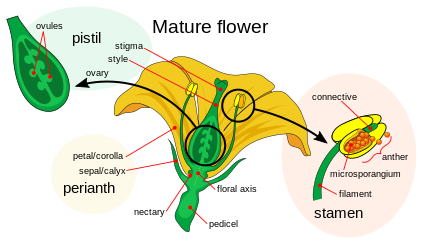
- Androecium (from Greek andros oikia: man's house): the next whorl (sometimes multiplied into several whorls), consisting of units called stamens. Stamens consist of two parts: a stalk called a filament, topped by an anther where pollen is produced by meiosis and eventually dispersed.
- Gynoecium (from Greek gynaikos oikia: woman's house): the innermost whorl of a flower, consisting of one or more units called carpels. The carpel or multiple fused carpels form a hollow structure called an ovary, which produces ovules internally. Ovules are megasporangia and they in turn produce megaspores by meiosis which develop into female gametophytes. These give rise to egg cells. The gynoecium of a flower is also described using an alternative terminology wherein the structure one sees in the innermost whorl (consisting of an ovary, style and stigma) is called a pistil. A pistil may consist of a single carpel or a number of carpels fused together. The sticky tip of the pistil, the stigma, is the receptor of pollen. The supportive stalk, the style, becomes the pathway for pollen tubes to grow from pollen grains adhering to the stigma. The relationship to the gynoecium on the receptacle is described as hypogynous (beneath a superior ovary), perigynous (surrounding a superior ovary), or epigynous (above inferior ovary).
The apple doesn’t fall far from the tree.”
The apple doesn’t fall far from the tree.”
Hazel was a holy tree in the days of Celtic paganism, associated with poetry and knowledge, fire and fertility. Its nuts are still connected in country belief with love and child-birth, and are used in divination on Halloween nights. Rods made from its wood formerly employed to detect hidden veins of metal in the earth, and water-diviners today often use forked hazel twigs for their work.
The fig tree is a sacred tree and figs an important fruit to many ancient people. It is still sacred in India, China and Japan and Moslems call the fig “Tree of Heaven” and revere it. The Greeks and Romans believed that the fig was a gift from the god of wine and agriculture.
In ancient Greece and Rome the hawthorn was linked with hope, marriage and babies. At wedding ceremonies the bridal attendants wore its blossoms and the bride carried a bough. However, in medieval Europe the hawthorn was regarded as an unlucky plant and that bringing it into a house would cause the death of a member of the household.
The weeping willow is a well-known symbol of unlucky love and mourning in the Western world. In the Orient it has been associated with the springtime regeneration of nature, eternal friendship, patience, perseverance and
“A life with love
“A life with love will have some thorns, but a life without love will have no roses.”
The rose is known as the queen of flowers. The white rose represents simplicity or happy love, the white rose is for innocence and purity, the yellow rose means perfect achievement and sometimes jealousy and the red rose signifies passion and sensual desire or shame and occasionally blood and sacrifice.
The name iris is the Greek word for the rainbow. They were planted on women’s graves.
In the last century in England, a bunch of violets worn around the neck or in the lapel protected against drunkenness.
Some species of flowers are considered unlucky in many parts of the world, particularly when brought into the house.
In Surrey the first primrose into the house meant sickness and sorrow.
In Norfolk, lilac was considered unlucky.
Red and white flowers in the same vase were unlucky, and even today some nurses will not have these flowers in the same vase on a ward.
Blue and orange flowers were welcome in homes and hospitals as these colours calm the nerves.
Honeysuckle, if brought into the house brought bad luck in Wales but foretold a wedding in Somerset.
Vegetative (Perianth)
Vegetative (Perianth)
Collectively the calyx and corolla form the perianth (see diagram).
- Calyx: the outermost whorl consisting of units called sepals; these are typically green and enclose the rest of the flower in the bud stage, however, they can be absent or prominent and petal-like in some species.
- Corolla: the next whorl toward the apex, composed of units called petals, which are typically thin, soft and colored to attract animals that help the process of pollination.
Flower and details
Flower
"All the flowers would have very extra special powers" This is a quote from Lewis Carroll's Alice in Wonderland. Flowers have been a symbol of peace and love throughout the ages. From the "Flower Power" movement of the 1960's, when activist and young pacifist Jane Rose Kasmir was photographed planting a flower on the bayonets of guards at the Pentagon during a protest against the Vietnam War on October 21, 1967. A Moment in time that would go on in American culture and heritage to reflect a moment of peace in a time of war, symbolizing a new type of passive resistance, coined by Ginsberg's 1965 essay titled How to Make a March/Spectacle. During the late 1800's a woman rejecting a suitor might send him yellow roses. During world war one a man leaving for a battle overseas might give his girlfriend forget-me-nots. Most people remember that red roses mean "I love you," but floriography itself has been largely forgotten, a Victorian practice where particular types of flowers meant different things. In some cases flowers may have a more grim representation such as calla lilies at a funeral. Recently evidence of flowers dating back to the prehistoric period have been discovered through 'Flower Fossils'. Archaeologists uncovered skeletons of a man, two women and an infant buried together in soil containing pollen of flowers in a cave in Iraq. This association of flowers with the cave dwelling Neanderthals of the Pleistocene epoch is indicative of the role of flowers in burial rituals. Analysis of the sediment pollen concentrated in batches, implied that possible bunches of flowers had been placed on the grave.
.jpg "flower")


 Description:flower,flower clip art,flower types,flower names,flower quotes,flower drawing,flower black and white,flower white background,flowers,flower tumblr,flower painting,flower wallpapers,flower love
Subscribe to:
Posts (Atom)